In August I received word that I was accepted into the next ProGen Study Program which started the beginning of this month. I am very happy with my fellow students and I am looking forward to learning from their vast experiences.
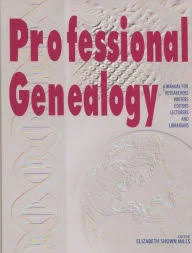
For those who may not know, the ProGen Study Program is an online study group that meets monthly for 19 months and each month one or more chapters of Professional Genealogy: A Manual for Researchers, Writers, Editors, Lecturers and Librarians[*], edited by Elizabeth Shown Mills (a Goddess in genealogy), is studied and homework is assigned regarding that assignment. Your fellow study group participants review your work and give you a critical assessment and support of your work. Likewise, you do the same for all the other participants. It is basically a peer driven system.
The study group is made up of various individuals from professional genealogists who want to hone their skills to the amateur genealogist who wish to conduct professional level research. The educational backgrounds of the participants can range from PhDs and Master Degrees to poor ol’ folks like me who are completely self-educated.
There is a decently long waiting list to get into this program and those who have completed it get to wear that ribbon with pride as it shows not only your knowledge of the subject but also displays the commitment you have to becoming a better genealogist.
As stated above, I was accepted into ProGen 32, the 32nd study group to form, and it began at the beginning of this month (October 2016). We have one “official” chat at the beginning of the month after the assignment has been sent out while the rest of the month is spent working on that assignment.
Our first assignment? Develop an educational plan based upon our professional preparedness.
As I stated, I am mostly self-educated. While there are excellent national conferences for genealogy they all occur too far for me to attend without creating an extreme financial drain on my family from fees, hotel, food, and travel coupled with the time away from work. I do attend local lectures and programs along with watching many, many videos, attending webinars, and reading a LOT. This has helped me this far but I feel I may lack from the contact and networking with other professional genealogists. It is amazing what you can absorb when simply hanging out with someone else.
When I look at what the other study group participants have been able to attend I become rather jealous of them. Jealous mostly because they are closer to the events than I am, but also of the things they have been able to learn and experience.
But then I come to my senses. I do not have that opportunity but I have taken full advantage of what I o have available to me. Yup, that proud self-educate polymath rears its head. LOL.
Anyway, our assignment was to develop an educational plan. I looked at what I have studied so far, I know where my weaknesses are, and the type of research I have been thrown into so I focused my plan on building those and expanding other skills that will support my focus.
A few of the items I listed was expanding my knowledge on DNA and how it applies to genealogy as well as furthering my skills in African-American genealogy and research. I have noticed in my African-American research I already take paths that I have not seen mentioned elsewhere so there seems to be a wide open field there.
I also posted a timeline of classes and studies. They include:
- Complete ProGen 32 (October 2016 through May 2018)
- Attend the 6th Forensic Genealogy Institute in San Antonio (March 7-9, 2017) Attend the Becoming an Expert: Law and the Forensic Genealogist track
- Take NGS The Basics and the NGS Guide to Documentation and Source Citation Courses (before May 2017)
- Take the NGS Beyond the Basics course (between May 2017 and December 2017)
- Take the NGS Branching Out Course (between December 2107 and May 2018)
- Take Boston University’s Genealogical Course (2018)
- Continue to attend webinars, watch online educational videos, and attend lectures/seminars at my local genealogical societies.
- Continue to read peer review material and publications such as the NGS Quarterly
Now that this is out, I have to do it. LOL
So, I figured I can continue to write about my educational advancements and projects, without giving too much away as far as assignments and such for those who wish to follow. Stay tuned and see my progress or meltdown. Either way is should be entertaining for you.
[*] Mills, Elizabeth Shown, Professional Genealogy: A Manual for Researchers, Writers, Editors, Lecturers and Librarians, Baltimore, Maryland: Genealogical Publishing Co., Inc., 2001.